What the HoneyFil panel lists
The label carries eight entries and nothing else. They divide into three groups, two and two and four, and the arithmetic works out at eight because the panel is printed line by line rather than gathered behind a single combined heading.
No proprietary blend appears anywhere on the bottle. A blend line is the usual way a label names ingredients without saying how they are divided; this one does not use that device. What it also does not do is publish a milligram figure beside each name, and that is worth stating plainly rather than leaving to be discovered. The per-ingredient amounts are not published by the manufacturer, so they are not published here either.
Everything below restates what is printed on the panel and describes what each entry is. It is a description of the ingredient, not a claim about what a serving of HoneyFil will do.
Vitamin B3 (Niacin)
Essential nutrient · Recognised daily value on the panel
Arrives as one thing and is used as another: the body converts it into the coenzyme pair that energy metabolism runs through.
Niacin is the older name for vitamin B3, and the body does not use it in the form it arrives in. It is rebuilt into two coenzymes, NAD and NADP, and from that point onward almost every reaction that releases energy from food passes through one of them. Because it is water soluble, the body holds almost no reserve and the panel value is refilled daily rather than topped up occasionally.
Zinc (as Zinc Oxide)
Essential mineral · Recognised daily value on the panel
Wide use, no reserve. Several hundred enzymes are built around it and the body banks almost none of it from one day to the next.
Zinc turns up as a structural component in several hundred enzymes, which is an unusual breadth for a single mineral. The body carries no meaningful store of it, so what is spent each day has to be replaced each day. That combination — wide use, no reserve — is the reason it appears on nearly every men's panel printed anywhere.
L-Citrulline
Amino acid · Amino acid, printed separately
The indirect route to arginine, and the more dependable one, because it clears the liver's first pass without being broken up.
L-citrulline is on the label for what it turns into rather than for what it is. It survives the first pass through the liver intact, which arginine taken directly does not, and it is converted to arginine downstream. Arginine is the precursor the body uses to widen a blood vessel, so citrulline is the more reliable way in.
L-Carnitine
Amino acid compound · Amino acid compound, printed separately
Transport rather than fuel. Stored fat reaches the part of the cell that can burn it only if something carries it across.
L-carnitine is a ferry rather than a fuel. Long-chain fatty acids cannot cross the inner mitochondrial membrane on their own; carnitine binds them and carries them over. Without that shuttle the fat is present in the cell but unavailable to the part of the cell that would burn it.
Pine Bark Extract
Botanical extract · Botanical extract, standardised
Taken from the French maritime pine and standardised on a marker compound, which is what makes one batch comparable to the next.
The bark of the French maritime pine is harvested from trees grown in plantations on the Atlantic coast, and the extract is standardised on its proanthocyanidin content. Standardisation is the part that matters: it is what lets a supplier show that this batch carries the same marker level as the last one.
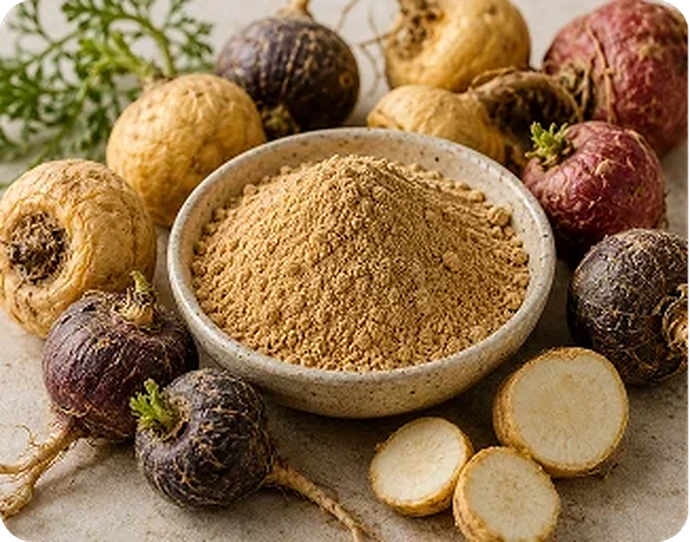
Maca Root Extract
Botanical extract · Botanical extract, standardised
Grown on the Peruvian altiplano, where frost is ordinary and the window for growing anything at all is measured in weeks.
Maca is a root crop farmed on the Peruvian high plateau, at altitudes where frost is routine and the growing season is brief. It has been eaten as food there for far longer than it has been sold as an extract, which is the honest way to describe its history rather than dressing it up as a discovery.
Grape Skin Extract
Botanical extract · Botanical extract, standardised
Concentrated from the part of the fruit a winery sets aside, which is also the part holding nearly all of its polyphenols.
Grape skin is what a winery presses off and sets aside, and it is also where the fruit keeps very nearly all of its polyphenols. The extract concentrates the skin rather than the juice, so the compounds that would otherwise be discarded are the ones that end up on the panel.
Saffron Stigmas Extract
Botanical extract · Botanical extract, standardised
Hand-picked, three threads to a flower. Nothing else named on this label costs anything close to it by weight.
Saffron is three crimson stigmas per crocus flower, each one lifted out by hand on the morning the flower opens. By weight it is the most expensive thing named anywhere on this label, and that price is a harvesting fact rather than a marketing position.
Three photographs that were left off this page
The asset pack supplied with this product included six ingredient photographs. Three of them are on the page above. The other three show plants that are not named anywhere on the HoneyFil panel, so they did not go on the site. An illustration of something the bottle does not contain is not decoration, it is a different product, and it has no place beside a formula page.
Where the reading behind this page came from
- Niacin — NIH Office of Dietary Supplements
- Zinc — NIH Office of Dietary Supplements
- Maca — NIH NCCIH herb summary
Those are reference pages about the ingredients themselves. None of them is about HoneyFil, and none of them is an endorsement of it.